
Saving whales from the lobsters


Woods Hole Oceanographic Institution scientist Mark Baumgartner said that to help the whales survive much longer, the rope Maine lobstermen use to tend their traps must be modified or even eliminated. And it's not just for the whales' sake.
"I feel the industry is in jeopardy,” Baumgartner said. 
Baumgartner was in Maine this month for the annual lobstermen's association meeting, to detail the whale's plight. If the lobster industry doesn't respond effectively, he said, the federal government will step in.
"As the population continues to decline and pressure is put on the government to do something about it, then they're going to turn to closures, because that's all they'll have," he said. 
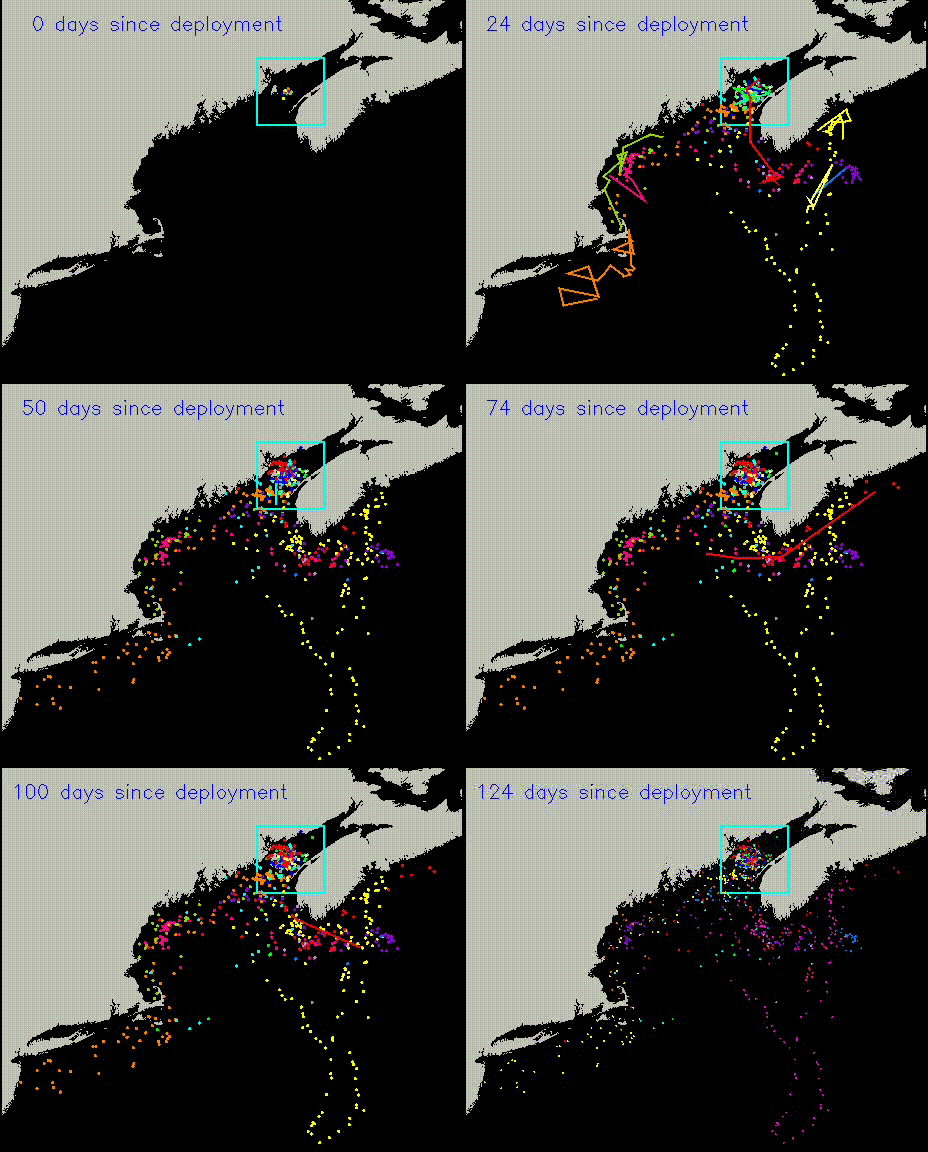
In four separate summers, the latest in 2000, scientist Mark Baumgartner and colleagues tagged 18 North Atlantic right whales and used satellite telemetry to chart their movements. What they found surprised them: the whales ranged far more widely around the Gulf of Maine than they had expected.CREDIT WOODS HOLE OCEANOGRAPHIC INSTITUTION
There were about 450 North Atlantic right whales estimated to be alive in 2016. Only five calves were born last year, while there were 17 deaths caused by rope and gear entanglement or ship strikes. Baumgartner said with no new births and another death already this year the trend-line is tipping toward the whale's effective extinction within 20 years.
But, his warnings are getting a somewhat frosty reception from Maine lobstermen.
"There was a lot of deaths on the right whales this year, but none in the Gulf of Maine," said Bob Williams, who has been hauling traps off Stonington, Maine for more than sixty years.

Comments

Popular posts from this blog

The blue whale in the red sea

Huge Blue Whale Sighted in the Red Sea for the First Time | Smart News | Smithsonian : "On Tuesday morning, a fisherman off the coast of Eilat, Israel spotted something unexpected: a huge whale swimming along in the Red Sea. Experts were even more surprised to discover that the creature was a blue whale—marking the first time that the world’s largest mammal has been seen in the Red Sea, as Zafrir Rinat and Almog Ben Zikri report for Haaretz.  Two days after it popped up in Israeli waters, Egypt’s environment ministry announced that the animal had also been sighted in the Red Sea’s Gulf of Aqaba, according to Aham Online. The ministry revealed that the whale measures 24 meters (nearly 80 feet) long, and belongs to a subspecies known as the pygmy blue whale. Monitoring teams in the South Sinai and the Red Sea have been deployed to track the whale’s movements." 'via Blog this'

An increase in the number of irrawaddy dolphins in the Mekong

Some good news this week about the Irrawaddy dolphins of the Mekong River. A joint report from the Cambodian government and the World Wildlife Foundation tells how,  following decades of seemingly irreversible decline, the population is increasing. They report the number of dolphins in the region has risen from 80 to 92 in the past two years—the first increase since scientists began keeping records more than twenty years ago. The first official census in 1997 estimated that there were 200 Irrawaddy dolphins in the Mekong, a figure that fell steadily due to bycatch and habitat loss. By 2015, only 80 dolphins remained. The recent census showed that more dolphins are surviving into adulthood, and there’s been a significant drop in overall deaths. Nine calves were born this year, raising the number of dolphins born in the past three years to 32. Seng Teak, Country Director of WWF Cambodia, said the census had positive implications for the Greater Mekong region, wher...

Killing whales for pet food

Ghastly photo taken on 27 June 2018 of blood pouring from a harpoon wound that killed a Fin whale in Iceland. So far 7 Fin whales have been killed out of the quota of 239. Fin whales are an endangered species & Iceland exports the meat to Japan where it often ends up in pet food. pic.twitter.com/9fVmRLkscZ — Quad Finn (@Quad_Finn) June 29, 2018